Customer Case: Live OTT freenet TV, Germany
Last updated: 14 October 2026
Cologne-based Media Broadcast GmbH is the leading provider of digital terrestrial television in Germany. For quite some years, Jet-Stream has been working for Media Broadcast on the live OTT streams of freenet TV, the German digital television platform that runs on a DVB-T2 HD network serving 5.9 million households. It is one of the most demanding live environments there is: the set-top boxes set their own clock, so every chunk has to be ready at exactly the right moment. Even so, the platform runs stably with high uptime, thanks to a fully redundant chain from encoder to origin shield and tight alignment between encoding, packaging, origin and CDN.
The customer: Media Broadcast and freenet TV
In Germany, Media Broadcast operates freenet TV, the digital live television service for private channels. freenet TV is a hybrid system: channels reach viewers both over the air (DVB-T2 HD) and as live OTT streams. For four years, Jet-Stream operates in the second part, the live OTT chain, running a 24*7 managed service.
The solution: a redundant live OTT chain
The channels are transcoded and packaged in MPEG-DASH, with DRM. The packagers then actively push the content to the origins over WebDAV: proactive push rather than passive pull, so the origin never has to fetch it.
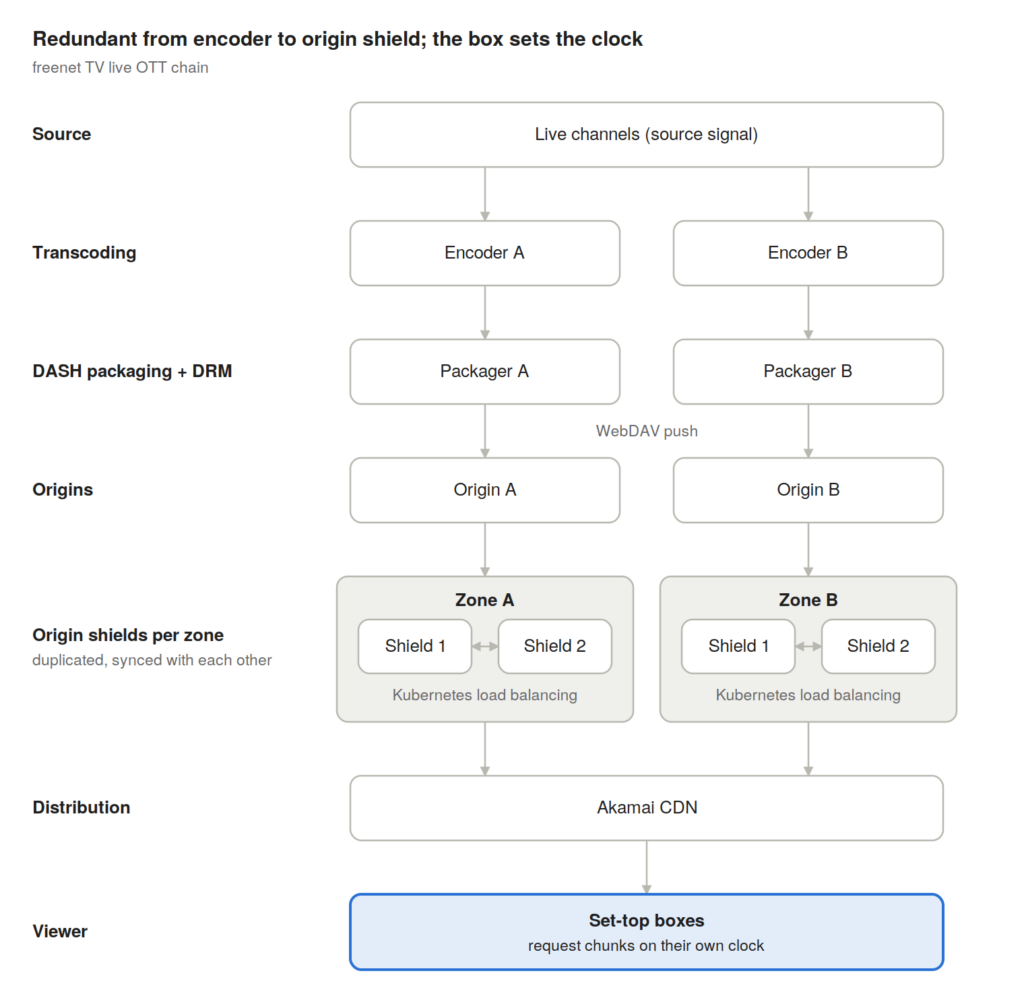
Every step is duplicated, from encoder up to and including the origin shields, for redundancy. Each zone also runs two origin shields that sync with each other, so there is no single point of failure even within a zone. A Kubernetes setup automatically balances the load across both shields within a zone, so Akamai can always reach the content. This CDN then handles distribution to the viewers. The synced timing contributes to flawless midstream switching.
The challenge: the set-top box sets the clock
What makes freenet TV exceptional is timing. The set-top boxes run on their own clock and decide for themselves which segment to request at which moment. The chain must therefore always be able to serve the right chunks at the right time, because a box does not wait.
There are several ways to manage timing in live streams. The most robust is content-anchored timing, where the clock is anchored in the content itself, in the timestamps of the source signal: the whole chain then follows neatly and absorbs variations along the way. The further downstream the clock becomes dominant, at the packager or even at the client, the heavier the demands on the rest of the stack.
With freenet TV, the clock sits at the very end, at the client. That is the most challenging situation there is: a small deviation in encoding, packaging, storage or distribution can show up directly for the viewer.
A legacy from the broadcast era
freenet TV connect launched in 2017 as an HbbTV service: the internet channels sit in between the receiver’s DVB channel list like any other, and viewers who zap to one get a live internet stream instead of an antenna signal without noticing the difference. At the time this hybrid DVB and OTT setup was a smart move, because it let a DVB-T2 platform expand its offering over the internet with many channels while offering viewers a unified experience.
The set top boxes of that era, however, were built with a broadcast mindset: the box itself decides when each segment should be there, just as a television expects the signal simply to be present. Over the air that works fine, because the transmitter sends and the box listens. With internet streaming that relationship is reversed: the viewer requests and the chain delivers.
That is why the streaming world today generally opts for timing anchored in the content itself. It is more robust, because the whole chain then moves along with small variations, instead of every link having to guess what an upstream component. A clock further down the end of the chain is technically not wrong, but it is a legacy from another era. We wrote about this difference in thinking earlier in The Broadcast Mindset versus the Internet Mindset.
What is more, that legacy does not simply disappear: the boxes are in people’s living rooms, doing their job. Replacing them is expensive and unnecessary, as long as the chain behind them is tuned well enough. That is exactly what Media Broadcast and Jet-Stream do together: modern, internet-minded infrastructure that adapts to devices from the broadcast era. Progress, after all, does not mean leaving your existing viewers behind.
Result: stable, with high uptime
Despite that difficult starting point, freenet TV runs stably with high uptime. That is no coincidence, but the result of good collaboration between the specialists at Media Broadcast and Jet-Stream, and of close alignment between every link in the chain: encoding, packaging, origin and CDN are tuned to each other, so the chunks are ready before the set-top box asks for them. The fully redundant setup, including redundancy per zone, also ensures that the failure of any single component stays invisible to the viewer.
Looking ahead: a standard pipeline in JTS
This service has been in successful production for four years. In the coming period, Media Broadcast and Jet-Stream will work together on developing this stack further in the new JTS platform. Precisely because freenet TV is such a challenging case, it is an ideal basis to build on: what runs stably under these strict timing requirements has ample headroom in less demanding environments. As a result, this setup will become available to everyone as one of the standard pipelines in JTS.